
Call for a Free Consultation
586.303.2211
Contested vs. Uncontested Divorce in Macomb County: Which Path Is Right for You?
An uncontested divorce is one where both spouses agree on every issue, while a contested divorce involves disagreement over custody, support, or property that the court must help resolve. Which path you take shapes how long your divorce lasts, what it costs, and how much stress it brings. Most Macomb County divorces fall somewhere in between and settle before trial. If you are weighing your options, our Macomb County divorce attorneys can help you figure out where your case is likely to land.
What is an uncontested divorce?
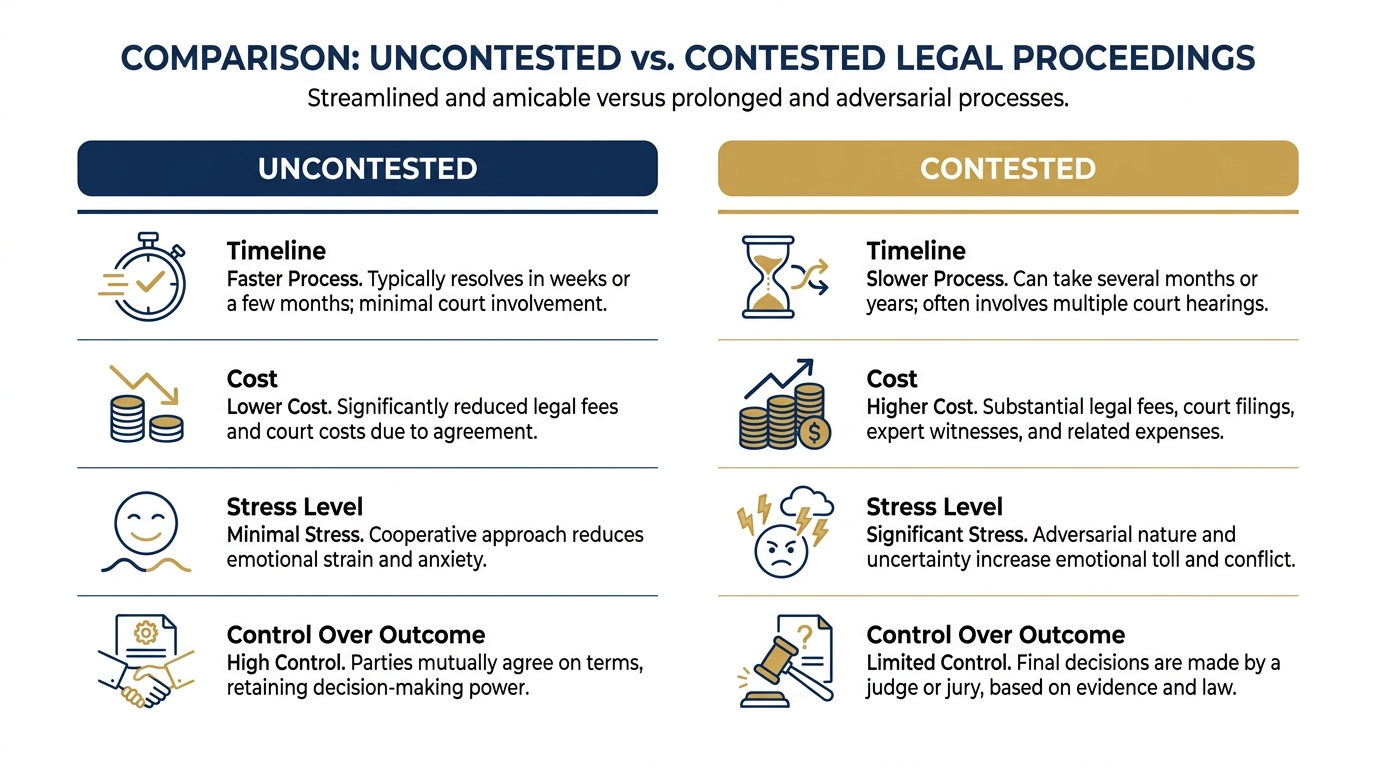
An uncontested divorce happens when both spouses agree on all terms, including custody, parenting time, child support, spousal support, and the division of property and debt. Because there is nothing for the judge to decide beyond approving the agreement, this path moves faster and costs less. In Michigan, even an agreed divorce must respect the mandatory waiting periods: a minimum of 60 days with no minor children, and a minimum of 180 days when minor children are involved. Couples who cooperate, keep communication civil, and have relatively simple finances are the best candidates for an uncontested divorce.
What is a contested divorce?
A contested divorce occurs when spouses cannot agree on one or more key issues and need the court, or a negotiated process, to resolve the dispute. Contested does not mean a courtroom trial is inevitable. It means there is a disagreement that must be worked out, whether over who keeps the house, how custody is shared, or how much support is fair. These cases take longer and cost more because they involve discovery, negotiation, and sometimes expert witnesses such as appraisers or custody evaluators. High-asset estates, custody disputes, and situations where one spouse suspects hidden income usually start contested.
How does mediation fit in?
Mediation is a middle ground where a neutral third party helps spouses reach an agreement without a trial, and Macomb County judges routinely refer couples to it. In the 16th Judicial Circuit Court, mediation is a standard step for custody and property disputes before a case is allowed to proceed to trial. A mediator does not decide the outcome. The mediator guides both sides toward a resolution they can both accept. Mediation often turns a contested case into a settled one, which saves time and money and gives the spouses more control than a judge’s ruling would. The Michigan Courts support mediation as a way to resolve family disputes efficiently.

Contested vs. uncontested divorce: a side-by-side comparison
Can a contested divorce become uncontested?
Yes, and it happens often. Many divorces in Macomb County start contested and settle before reaching trial. As discovery reveals the full financial picture and mediation narrows the disagreements, spouses frequently reach an agreement on their own terms. Settling has real advantages. It keeps the decision in your hands rather than the judge’s, lowers cost, and shortens the timeline. Even cases that feel adversarial at the start can end in a negotiated settlement with the right strategy.
Do you need a lawyer for an uncontested divorce?
You are not legally required to hire an attorney, but even an agreed divorce involves binding decisions about your finances and your children that are difficult to undo. A small error in a property settlement or a vaguely worded parenting plan can cause problems for years. An attorney makes sure the paperwork is correct, the agreement is enforceable, and you are not giving up rights you did not know you had. For contested cases, legal representation is close to essential because the other side’s positions directly affect what you keep.
Frequently asked questions
Is an uncontested divorce cheaper in Michigan?
Yes. An uncontested divorce is almost always cheaper because it requires less attorney time, fewer court appearances, and no costly discovery or expert witnesses. The main expenses are court filing fees and the attorney time needed to prepare and review the agreement.
How long does a divorce take in Macomb County?
Michigan requires a minimum 60-day waiting period for couples with no minor children and a minimum 180-day waiting period when minor children are involved. An uncontested divorce often resolves near those minimums, while a contested divorce can take several months to more than a year.
Is mediation required in a Macomb County divorce?
Macomb County judges in the 16th Judicial Circuit Court routinely refer couples to mediation for custody and property disputes before allowing a case to proceed to trial. Mediation is a standard step that often helps spouses settle without a courtroom hearing.
What happens if my spouse and I cannot agree?
If you cannot agree, your divorce is contested. The process moves through discovery and negotiation, usually including mediation. If you still cannot resolve every issue, a judge decides the remaining disputes at trial.
Can a contested divorce become uncontested?
Yes. Many contested divorces settle before trial once both sides exchange financial information and work through mediation. Settling gives the spouses control over the outcome and usually costs less than a trial.

Not sure which path you are facing?
Whether your divorce stays cooperative or turns into a dispute, the right strategy early on saves you money and protects what matters. The attorneys at Aiello & Associates help Macomb County couples find the most efficient path through divorce, from a straightforward uncontested filing to a hard-fought custody case. Call 586-303-2211 or schedule a free case evaluation and we will help you understand your options before you take the next step.

Related Posts

September
Legal Separation vs. Divorce in Michigan: What “Separate Maintenance” Really Means
Michigan does not have "legal separation" the way many other states do. Instead, it offers a court action called separate maintenance, which follows almost the same process as a divorce but leaves the marriage legally intact at the end. A separate maintenance judgment can divide…

September
Fathers’ Rights in Michigan: Custody, Parenting Time, and Common Myths
In Michigan, fathers' rights to custody and parenting time are equal to a mother's. Family court judges decide custody using the 12 best interest factors in MCL 722.23, and the law forbids favoring either parent because of gender. The idea that mothers automatically win custody…

August
Divorce Mediation in Macomb County: How It Works, What It Costs, and When It’s Required
Divorce mediation is a process where a neutral third party helps both spouses reach an agreement on custody, support, and property without a trial. In Macomb County, the 16th Judicial Circuit Court routinely refers divorcing couples to mediation for custody and property disputes before a…
Start With A Free Initial Consultation
Email us below or call 586-303-2211 to learn your legal options.
Contact Us Today!

Attorney Advertising. This information is designed for general information only. The information presented should not be construed to be formal legal advice nor the formation of a lawyer/client relationship. Past results and testimonials are not a guarantee, warranty, or prediction of the outcome of your case, and should not be construed as such. Past results cannot guarantee future performance. Any result in a single case is not meant to create an expectation of similar results in future matters because each case involves many different factors, therefore, results will differ on a case-by-case basis. By providing contact information, users acknowledge and give explicit consent to be contacted via the methods of communication provided, including SMS. Message and data rates may apply. Message frequency may vary. Reply STOP to opt out.
Attorney Advertising. This information is designed for general information only. The information presented should not be construed to be formal legal advice nor the formation of a lawyer/client relationship. Past results and testimonials are not a guarantee, warranty, or prediction of the outcome of your case, and should not be construed as such. Past results cannot guarantee future performance. Any result in a single case is not meant to create an expectation of similar results in future matters because each case involves many different factors, therefore, results will differ on a case-by-case basis. By providing contact information, users acknowledge and give explicit consent to be contacted via the methods of communication provided, including SMS. Message and data rates may apply. Message frequency may vary. Reply STOP to opt out.
Copyright 2026 | All Rights Reserved | Privacy Policy | Terms Of Use | Accessibility Notice