
Call for a Free Consultation
586.303.2211
Spousal Support in Michigan: How Alimony Is Decided in Macomb County
Michigan courts decide spousal support, also called alimony, case by case using a set of fairness factors rather than a fixed formula. There is no calculator that spits out an amount the way child support works. A judge in the 16th Judicial Circuit Court, which handles divorce for all of Macomb County, weighs things like the length of the marriage and each spouse’s ability to earn, then decides whether support is appropriate, how much, and for how long. If you are worried about paying or receiving alimony, our spousal support attorneys can help you understand where your case likely stands.
What is spousal support in Michigan?
Spousal support is money one spouse pays the other during or after a divorce to address an imbalance in income or earning ability. Its purpose is to help a lower-earning spouse maintain a reasonable standard of living and become self-supporting when possible. Michigan law does not treat alimony as automatic or as a reward. It exists to balance the financial needs of one spouse against the other’s ability to pay, and either spouse can request it regardless of gender.
What are the types of spousal support?
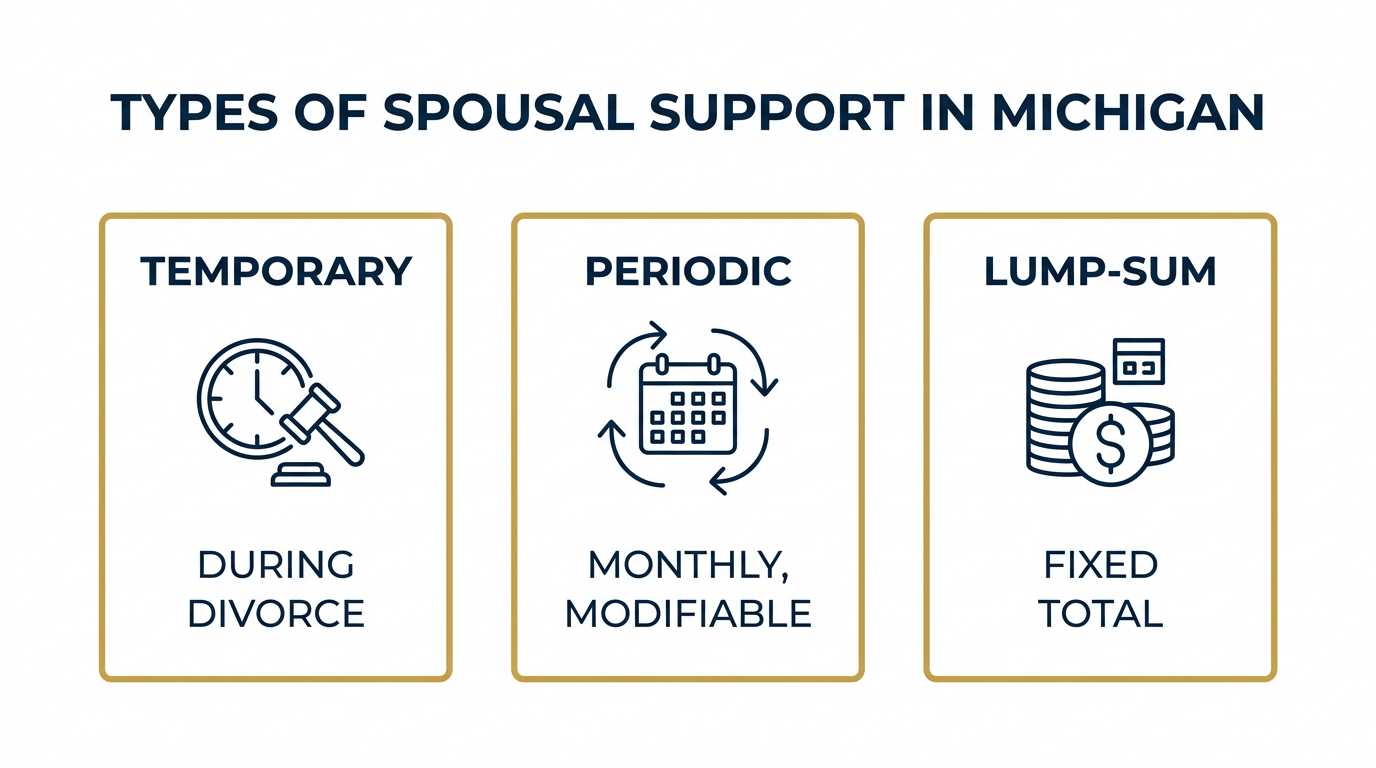
Michigan recognizes several forms of spousal support, and a case can involve more than one. The type shapes how long payments last and whether they can be changed later.
Temporary support
Temporary support, ordered while the divorce is pending, helps a spouse cover living expenses until the case is final. It ends when the judgment of divorce is entered.
Periodic support
Periodic support is paid in regular installments, usually monthly, for a set period or until a specific event such as remarriage. This is the most common form, and it can generally be modified if circumstances change.
Lump-sum support
Lump-sum support is a fixed total, sometimes paid all at once or in defined installments. Because the amount is set, it usually cannot be modified later, which gives both spouses certainty.
What factors do Michigan judges consider for alimony?
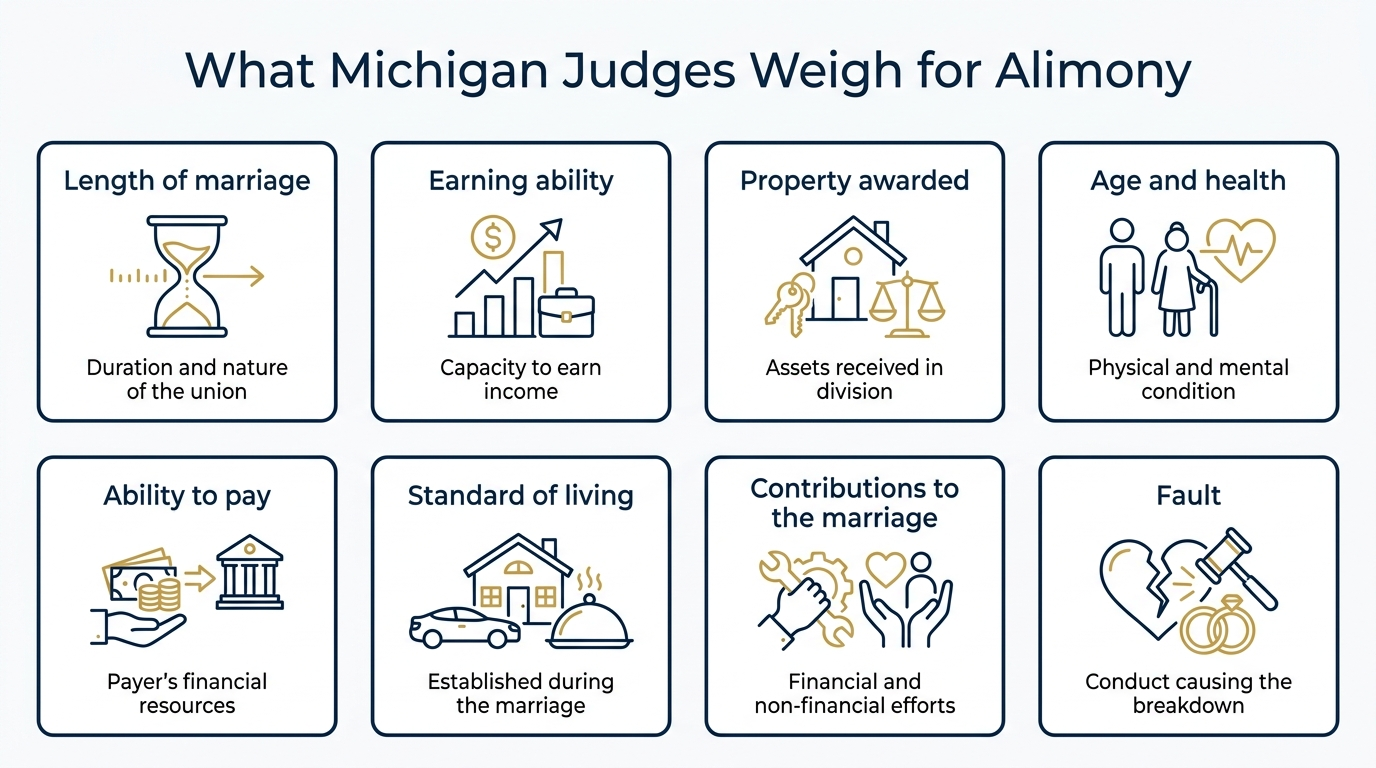
Judges weigh a list of factors drawn from Michigan case law, most notably the decision in Sparks v. Sparks, to decide whether support is fair. No single factor controls, and the court balances all of them together. The main considerations include:
- The length of the marriage
- Each spouse’s ability to work and earn a living
- The source and amount of property awarded in the divorce
- The age and health of each spouse
- The paying spouse’s ability to pay
- The present situation and needs of each spouse
- The standard of living during the marriage
- Each spouse’s contributions to the marital estate, including as a homemaker
- Fault or conduct during the marriage
- General principles of fairness
A long marriage with a large income gap is the classic situation where support is awarded. A short marriage between two spouses who both work full time is far less likely to result in alimony. You can review how Michigan appellate courts frame these questions through the Michigan Courts.
How long does spousal support last?
The duration depends on the marriage and the spouses’ circumstances, because Michigan sets no mandatory schedule. Support tied to a shorter marriage may last only a few years, long enough for the receiving spouse to gain job skills or re-enter the workforce. Support after a long marriage, especially where one spouse left the workforce to raise children, can last much longer and occasionally continues indefinitely. Periodic support usually ends automatically if the receiving spouse remarries, and often if that spouse begins cohabiting with a new partner in a marriage-like arrangement.
Can a spousal support order be changed?
Periodic spousal support can usually be modified when there is a significant change in circumstances, while lump-sum support generally cannot. If the paying spouse loses a job, retires, or suffers a serious health decline, or if the receiving spouse’s income rises substantially, either party can ask the court to adjust the amount. The spouse requesting the change has to show the change in circumstances was material and not something they created in bad faith, such as quitting a job to avoid paying. Until the court enters a new order, the existing amount stays due, so filing promptly matters.
How is alimony taxed?
For divorces finalized after 2018, spousal support is not tax-deductible for the paying spouse and is not taxable income for the receiving spouse under federal law. This changed with the Tax Cuts and Jobs Act, and it affects how spouses negotiate amounts, since the paying spouse no longer gets a deduction. Because tax treatment can influence the overall settlement, it is worth discussing with an attorney who can model the real after-tax picture.
Frequently asked questions
Is there an alimony calculator in Michigan?
No. Michigan has no fixed formula or official calculator for spousal support. Judges decide whether to award it, how much, and for how long based on fairness factors such as the length of the marriage, each spouse’s earning ability, and the standard of living during the marriage.
How long do you have to pay spousal support in Michigan?
Duration varies with the marriage. Support after a short marriage may last only a few years, while support after a long marriage can last much longer or occasionally indefinitely. Periodic support usually ends if the receiving spouse remarries.
Can a husband receive alimony in Michigan?
Yes. Spousal support is not based on gender. Either spouse can request it, and courts award it based on financial need and the other spouse’s ability to pay, regardless of who earns more.
Can spousal support be changed after the divorce?
Periodic spousal support can usually be modified when there is a significant change in circumstances, such as job loss, retirement, or a large income increase. Lump-sum support generally cannot be changed. The existing order stays in effect until the court enters a new one.
Does spousal support end if my ex remarries?
Periodic spousal support in Michigan generally ends automatically when the receiving spouse remarries, and it can also end if that spouse begins cohabiting with a new partner in a marriage-like relationship. Lump-sum support usually is not affected.

Talk to a Macomb County spousal support attorney
Because alimony comes down to how a judge weighs the facts of your marriage, strong preparation and a clear financial picture make a real difference. The attorneys at Aiello & Associates help Macomb County spouses pursue fair support or defend against an unreasonable request. Call 586-303-2211 or schedule a free consultation to talk through what support might look like in your case.

Related Posts

September
Legal Separation vs. Divorce in Michigan: What “Separate Maintenance” Really Means
Michigan does not have "legal separation" the way many other states do. Instead, it offers a court action called separate maintenance, which follows almost the same process as a divorce but leaves the marriage legally intact at the end. A separate maintenance judgment can divide…

September
Fathers’ Rights in Michigan: Custody, Parenting Time, and Common Myths
In Michigan, fathers' rights to custody and parenting time are equal to a mother's. Family court judges decide custody using the 12 best interest factors in MCL 722.23, and the law forbids favoring either parent because of gender. The idea that mothers automatically win custody…

August
Divorce Mediation in Macomb County: How It Works, What It Costs, and When It’s Required
Divorce mediation is a process where a neutral third party helps both spouses reach an agreement on custody, support, and property without a trial. In Macomb County, the 16th Judicial Circuit Court routinely refers divorcing couples to mediation for custody and property disputes before a…
Start With A Free Initial Consultation
Email us below or call 586-303-2211 to learn your legal options.
Contact Us Today!

Attorney Advertising. This information is designed for general information only. The information presented should not be construed to be formal legal advice nor the formation of a lawyer/client relationship. Past results and testimonials are not a guarantee, warranty, or prediction of the outcome of your case, and should not be construed as such. Past results cannot guarantee future performance. Any result in a single case is not meant to create an expectation of similar results in future matters because each case involves many different factors, therefore, results will differ on a case-by-case basis. By providing contact information, users acknowledge and give explicit consent to be contacted via the methods of communication provided, including SMS. Message and data rates may apply. Message frequency may vary. Reply STOP to opt out.
Attorney Advertising. This information is designed for general information only. The information presented should not be construed to be formal legal advice nor the formation of a lawyer/client relationship. Past results and testimonials are not a guarantee, warranty, or prediction of the outcome of your case, and should not be construed as such. Past results cannot guarantee future performance. Any result in a single case is not meant to create an expectation of similar results in future matters because each case involves many different factors, therefore, results will differ on a case-by-case basis. By providing contact information, users acknowledge and give explicit consent to be contacted via the methods of communication provided, including SMS. Message and data rates may apply. Message frequency may vary. Reply STOP to opt out.
Copyright 2026 | All Rights Reserved | Privacy Policy | Terms Of Use | Accessibility Notice