
Call for a Free Consultation
586.303.2211
How to Modify a Custody, Parenting Time, or Child Support Order in Macomb County
To modify a custody order, a parenting time order, or a child support order in Macomb County, you file a motion with the court that issued it and show either proper cause or a change of circumstances since the last order. A judge in the Family Division of the 16th Judicial Circuit Court, or the Macomb County Friend of the Court, then reviews the request. Orders are not automatically updated when life changes, so the burden is on you to ask. If your situation has shifted, our family law modification attorneys can help you decide whether a change is worth pursuing.
When can you modify a family court order in Michigan?
You can request a modification when there has been a significant change since the current order was entered, not just because you are unhappy with it. Michigan requires the person asking for the change to show proper cause or a change of circumstances. Minor or short-term changes usually do not qualify. The change generally has to be substantial, ongoing, and something that was not already considered when the last order was set.
What is the standard for changing custody?
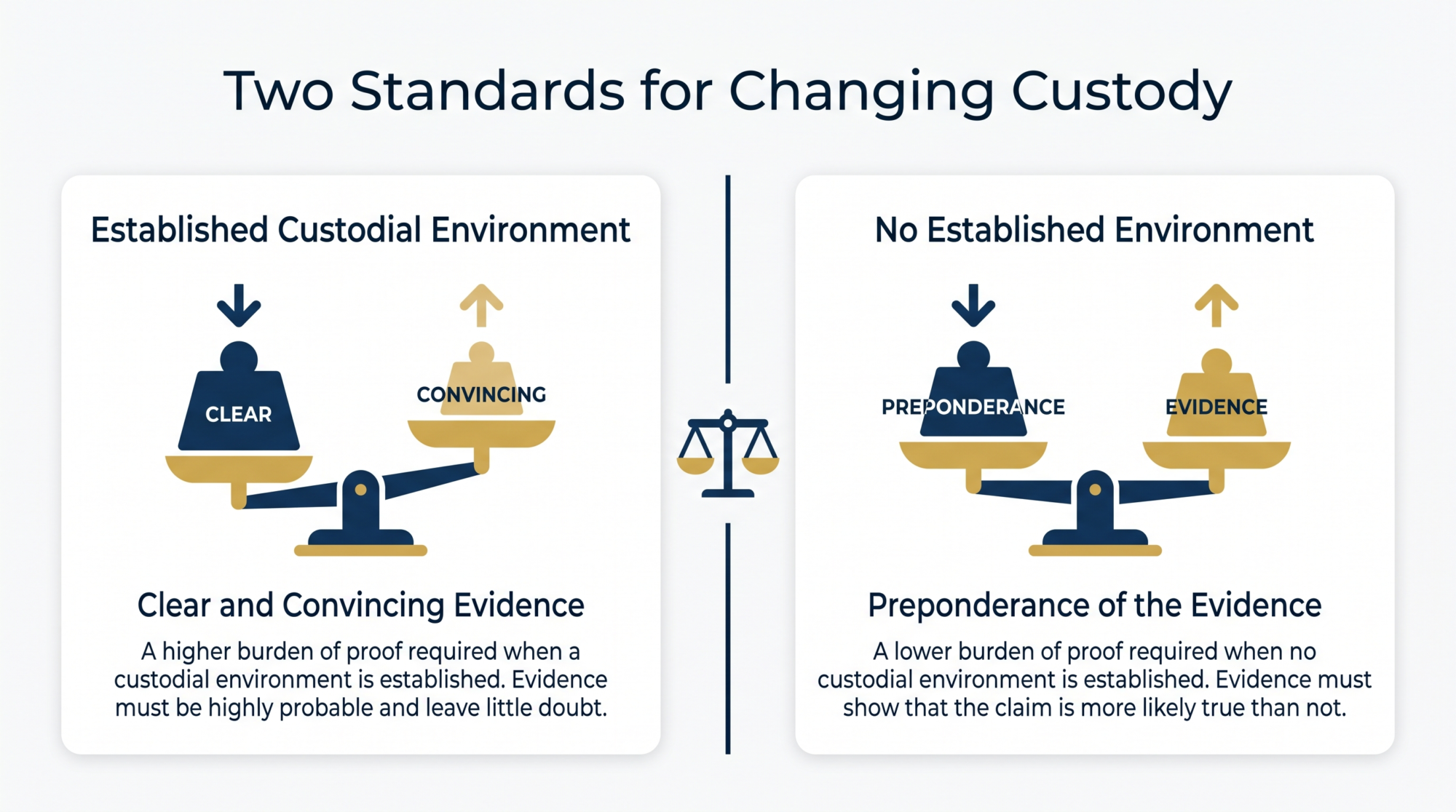
Custody changes face a higher bar than support changes because courts protect stability for the child. The key question is whether an established custodial environment exists, meaning the child looks to a parent for guidance, discipline, and daily needs over an appreciable time. If changing custody would alter that environment, the parent seeking the change must prove by clear and convincing evidence that the change serves the child’s best interests under the 12 factors in MCL 722.23. If no established environment exists, or the change would not disturb it, the lower preponderance-of-the-evidence standard applies. This distinction often decides the case, so it is worth understanding before you file.
What counts as a change of circumstances?
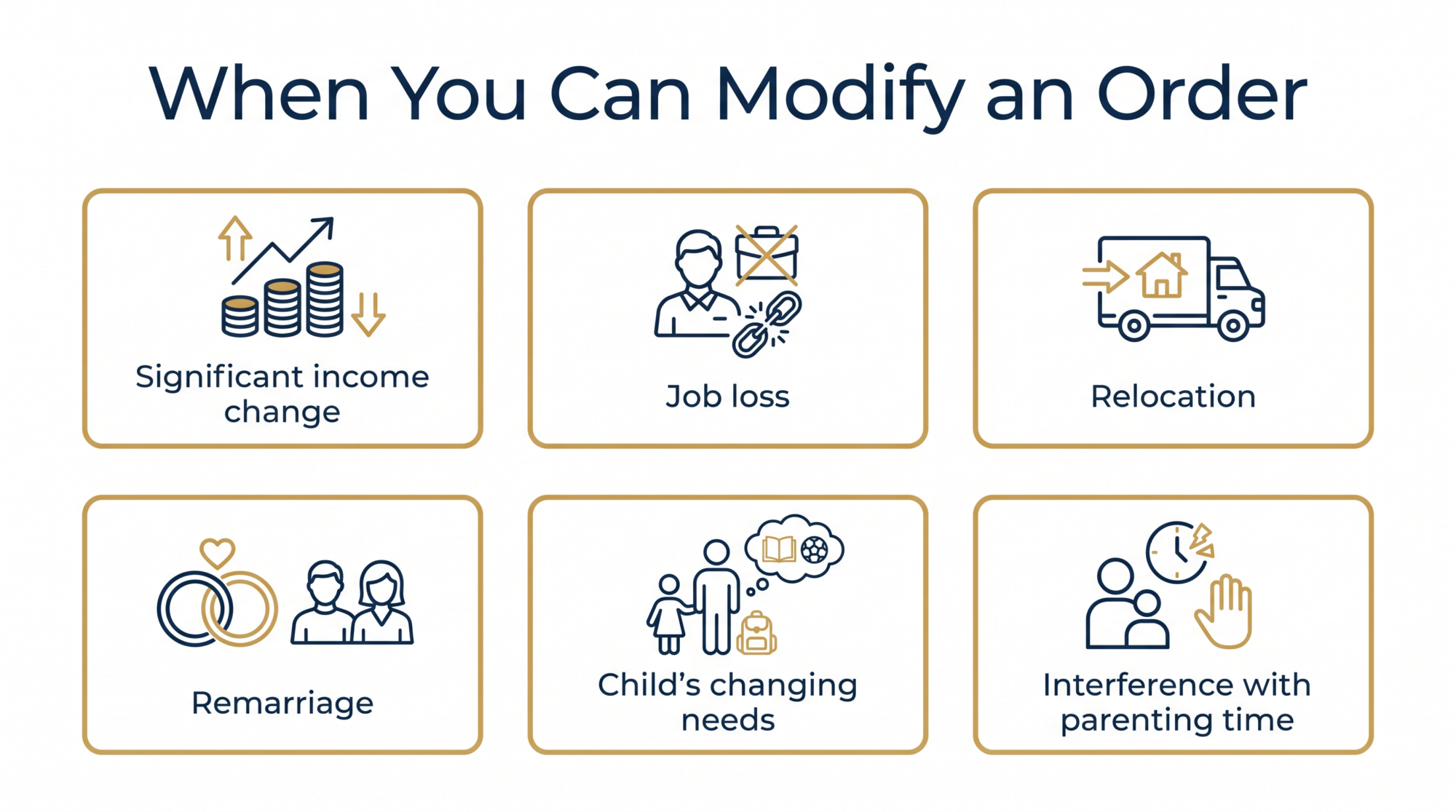
A qualifying change is one that materially affects the child or a parent’s ability to meet the order. Common examples that Macomb County parents bring to court include:
- A significant, lasting change in either parent’s income, such as a job loss, a raise, or a new career
- A parent’s relocation that affects the parenting schedule
- A remarriage or a new household situation
- A change in the child’s medical, educational, or emotional needs
- A parent repeatedly denying or interfering with parenting time
- Concerns about a child’s safety in one home
Everyday disagreements, a single missed exchange, or normal changes as a child grows usually are not enough on their own. The court looks for something that meaningfully changes the picture it saw when it entered the last order.
How do you change a child support order?
Child support is modified by recalculating support under the current numbers when a parent’s income, parenting time, or the child’s costs change. Either parent can file a motion, or ask the Macomb County Friend of the Court to review the order. Michigan lets you request a Friend of the Court review roughly every 36 months without showing a special reason, and sooner when a major change justifies it. The court then reruns the Michigan Child Support Formula with current income, overnights, health insurance, and childcare figures. One point trips up many parents: support does not change on its own when your income drops. The existing amount stays due until the court enters a new order, and it is not lowered for the time before you filed, so acting quickly protects you.
How do you file for a modification in Macomb County?
Modifications start with a motion filed in the 16th Judicial Circuit Court, the court that handles family cases for Macomb County. You file the motion, serve the other parent so they can respond, and attend a hearing where the judge or a referee reviews the evidence. For support, the Friend of the Court often handles the review and recommendation first. Bringing clear documentation, such as pay records, a new work schedule, medical records, or a parenting time log, makes a real difference. The Macomb County Circuit Court publishes local procedures and forms through the Macomb County Circuit Court. Because the standards are technical, many parents have an attorney prepare the motion and present the evidence in the way the court expects.
Frequently asked questions
How often can you modify child support in Michigan?
You can ask the Macomb County Friend of the Court to review a child support order about every 36 months without showing a special reason, and sooner if there is a substantial change such as a job loss or a large income increase. The court recalculates support using current figures.
What do I have to prove to change custody in Michigan?
If an established custodial environment exists, you must prove by clear and convincing evidence that the change serves the child’s best interests under the 12 factors in MCL 722.23. If no established environment exists or the change would not disturb it, the lower preponderance-of-the-evidence standard applies.
Does my child support automatically drop if I lose my job?
No. Support does not change on its own. The existing order stays in effect and continues to accrue until the court enters a new one, and it is not reduced retroactively for the period before you file. File a motion or request a Friend of the Court review promptly.
Where do I file to modify a custody or support order in Macomb County?
You file a motion in the Family Division of the 16th Judicial Circuit Court, the court that entered the original order. For child support, the Macomb County Friend of the Court often reviews the request and makes a recommendation first.
Can I modify parenting time without changing custody?
Yes. Parenting time can be adjusted on its own when circumstances change, and it generally uses a lower standard than a change of custody because it does not alter who has custody. The court still focuses on the child’s best interests.

Ready to update your order? Talk to Aiello & Associates
Life rarely matches the order you signed a few years ago, and waiting to act can cost you money and time with your children. The attorneys at Aiello & Associates help Macomb County parents modify custody, parenting time, and support orders and present the evidence the court needs to see. Call 586-303-2211 or schedule a free consultation to find out whether your circumstances support a modification.

Related Posts

August
Divorce Mediation in Macomb County: How It Works, What It Costs, and When It’s Required
Divorce mediation is a process where a neutral third party helps both spouses reach an agreement on custody, support, and property without a trial. In Macomb County, the 16th Judicial Circuit Court routinely refers divorcing couples to mediation for custody and property disputes before a…

August
How to Modify a Custody, Parenting Time, or Child Support Order in Macomb County
To modify a custody order, a parenting time order, or a child support order in Macomb County, you file a motion with the court that issued it and show either proper cause or a change of circumstances since the last order. A judge in the…

July
Can I Move Out of State With My Child After a Michigan Divorce? Change of Domicile Rules
In most cases, no, not without either the other parent's consent or the court's permission. Michigan's change of domicile law (MCL 722.31) generally bars a parent who shares custody from moving a child more than 100 miles from where the child lived when the case…
Start With A Free Initial Consultation
Email us below or call 586-303-2211 to learn your legal options.
Contact Us Today!

Attorney Advertising. This information is designed for general information only. The information presented should not be construed to be formal legal advice nor the formation of a lawyer/client relationship. Past results and testimonials are not a guarantee, warranty, or prediction of the outcome of your case, and should not be construed as such. Past results cannot guarantee future performance. Any result in a single case is not meant to create an expectation of similar results in future matters because each case involves many different factors, therefore, results will differ on a case-by-case basis. By providing contact information, users acknowledge and give explicit consent to be contacted via the methods of communication provided, including SMS. Message and data rates may apply. Message frequency may vary. Reply STOP to opt out.
Attorney Advertising. This information is designed for general information only. The information presented should not be construed to be formal legal advice nor the formation of a lawyer/client relationship. Past results and testimonials are not a guarantee, warranty, or prediction of the outcome of your case, and should not be construed as such. Past results cannot guarantee future performance. Any result in a single case is not meant to create an expectation of similar results in future matters because each case involves many different factors, therefore, results will differ on a case-by-case basis. By providing contact information, users acknowledge and give explicit consent to be contacted via the methods of communication provided, including SMS. Message and data rates may apply. Message frequency may vary. Reply STOP to opt out.
Copyright 2026 | All Rights Reserved | Privacy Policy | Terms Of Use | Accessibility Notice