
Call for a Free Consultation
586.303.2211
Can I Move Out of State With My Child After a Michigan Divorce? Change of Domicile Rules
In most cases, no, not without either the other parent’s consent or the court’s permission. Michigan’s change of domicile law (MCL 722.31) generally bars a parent who shares custody from moving a child more than 100 miles from where the child lived when the case began, and any move out of state usually requires approval regardless of distance. A judge in the 16th Judicial Circuit Court decides these requests for Macomb County families using five specific factors. If you are planning a move or trying to stop one, our change of domicile attorneys can explain what the court will expect.
What is Michigan’s 100-mile rule?
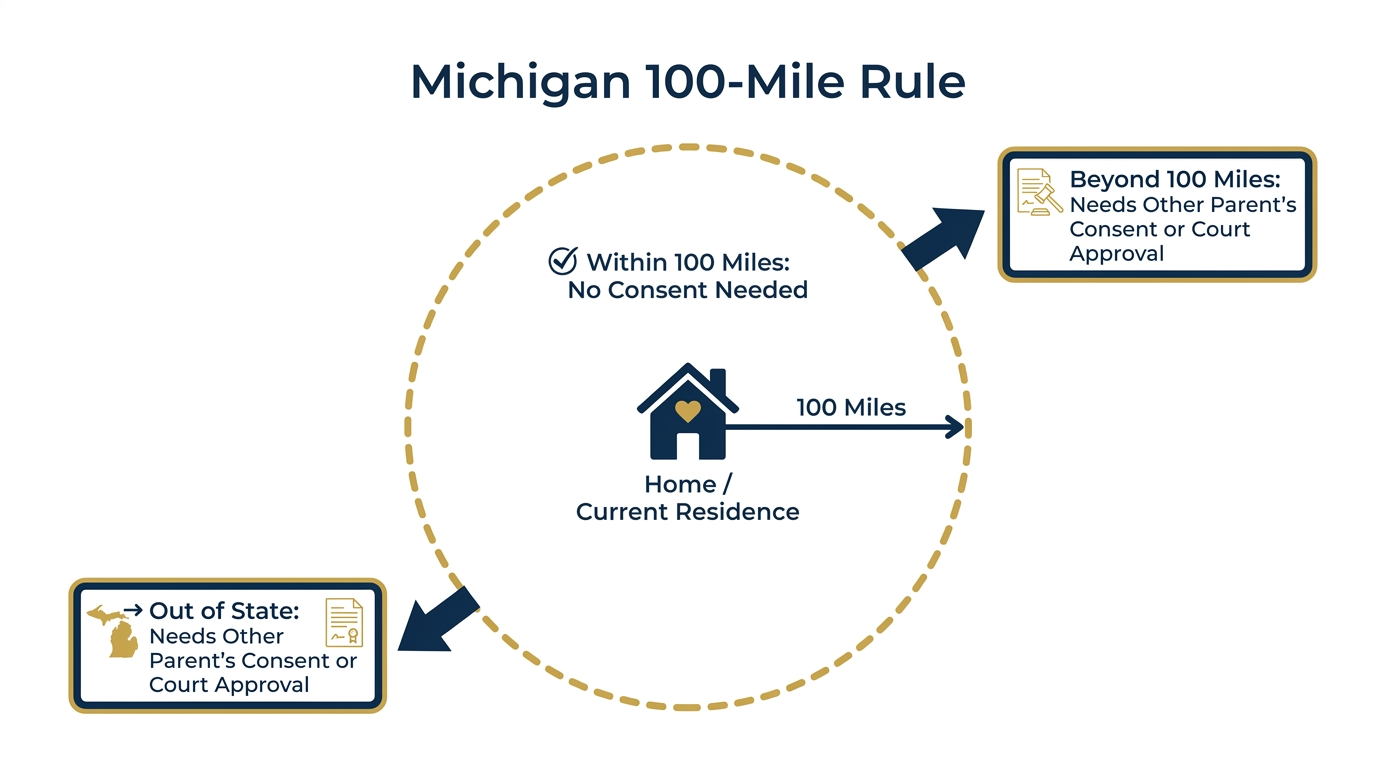
The 100-mile rule prevents a parent with joint legal custody from relocating a child more than 100 miles from the child’s legal residence at the time the custody case started, unless the other parent agrees or the court approves. The distance is measured in a straight line from the original home, not by driving miles. A few situations fall outside the rule. It does not apply if both parents already live more than 100 miles apart, if the move actually brings the child closer to the other parent, or if one parent has sole legal custody. Out-of-state moves are treated separately and generally need court approval even if the new home is fewer than 100 miles away.
When do you need court permission to move?
You need court permission whenever the move would exceed 100 miles or cross state lines and the other parent does not consent. The cleanest path is written agreement from the other parent, which the court can then approve. Without that agreement, the moving parent must file a motion for change of domicile and ask the judge to allow the relocation. Moving first and asking later is a serious mistake that can damage your custody position, so the request should come before any move.
What are the five change of domicile factors?
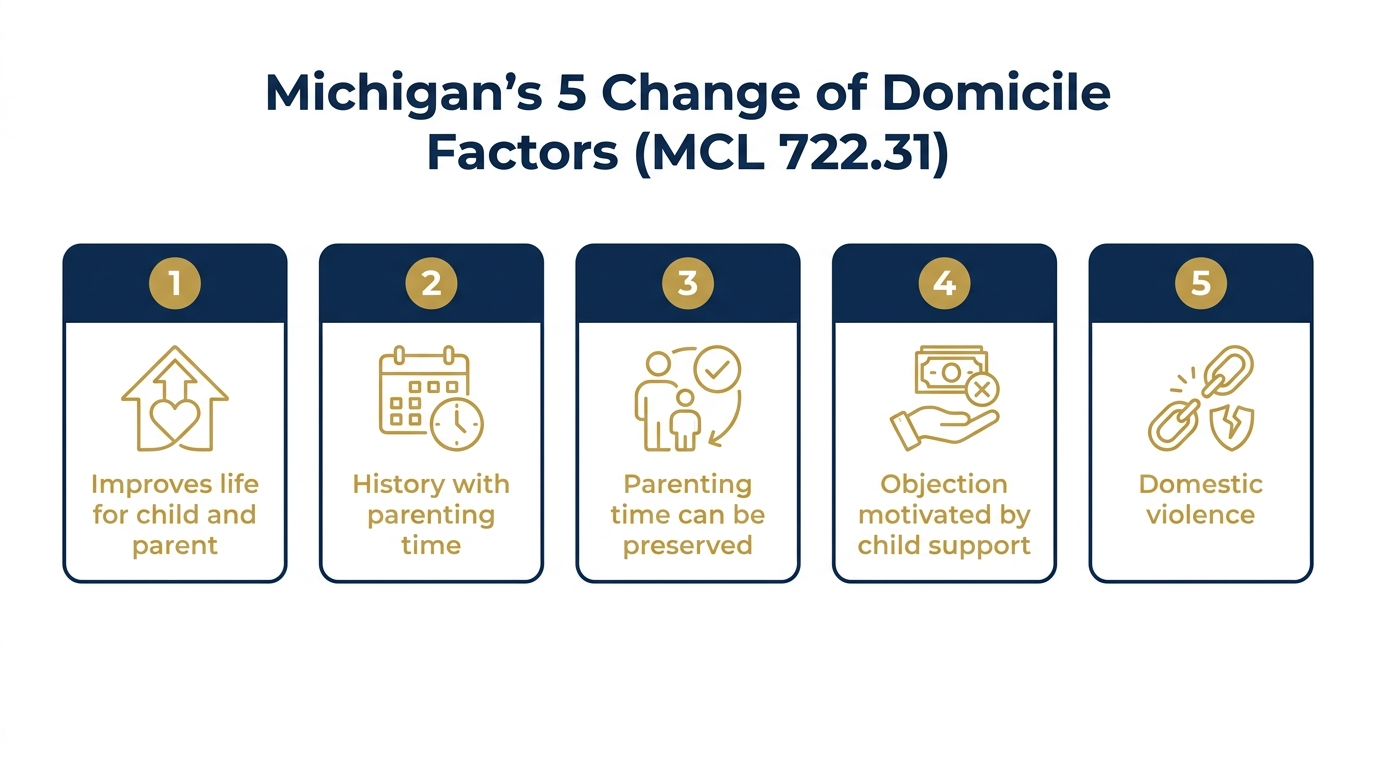
Michigan judges evaluate a relocation request using five factors listed in MCL 722.31(4). The court weighs them together to decide whether the move serves the child’s interests, not just the parent’s convenience.
1. Whether the move improves life for the child and parent
The court looks at whether the relocation has the capacity to improve the quality of life for both the child and the relocating parent, such as a better job, family support, or a stronger living situation.
2. Each parent’s history with parenting time
The judge considers how well each parent has followed the parenting time schedule and whether the request to move, or the objection to it, is an attempt to frustrate the other parent’s time with the child.
3. Whether parenting time can be preserved
The court examines whether a realistic modified schedule can maintain the relationship between the child and the non-moving parent, and whether the moving parent is likely to honor it.
4. Whether the objection is about money
The judge weighs whether the parent opposing the move is motivated partly by a desire to reduce or avoid a child support obligation rather than genuine concern about the relationship.
5. Domestic violence
Any history of domestic violence, whether directed at the child or a parent, is considered and can weigh heavily against a parent involved in it.
How does a move affect custody and parenting time?
Even when a court approves a relocation, it usually restructures parenting time to protect the child’s relationship with the parent left behind. That often means longer but less frequent visits, such as extended summer and holiday blocks, plus regular video contact. The parent who moves is typically expected to shoulder more of the travel burden and cost. If the move is denied, the parent remains free to relocate personally, but the child stays, which can force a hard choice. You can read the exact statutory language on the Michigan Legislature website.
What happens if a parent moves without permission?
Moving a child in violation of the 100-mile rule or an out-of-state restriction can bring real consequences. The other parent can file an emergency motion, and the court can order the child returned, hold the moving parent in contempt, and treat the violation as a strike against that parent in any custody review. Courts take unilateral moves seriously because they disrupt the child and undercut the other parent’s rights. If you feel you have a strong reason to relocate, the safer route is to ask the court first and let a judge weigh the five factors.
Frequently asked questions
What is the 100-mile rule in Michigan?
The 100-mile rule (MCL 722.31) prevents a parent with joint legal custody from moving a child more than 100 miles from the child’s legal residence at the time the case began, unless the other parent consents or the court approves. Distance is measured in a straight line, not driving miles.
Can I move out of state with my child after a Michigan divorce?
Usually not without the other parent’s consent or court permission. Out-of-state moves generally require court approval even if the new home is fewer than 100 miles away, unless the other parent has no custody rights.
What factors does a Michigan court consider for relocation?
Courts weigh five factors from MCL 722.31: whether the move improves life for the child and parent, each parent’s history with parenting time, whether parenting time can be preserved, whether the objection is motivated by reducing child support, and any domestic violence.
What happens if I move without the court’s permission?
The other parent can file an emergency motion, and the court can order the child returned, hold you in contempt, and count the violation against you in a custody review. Unilateral moves that break the 100-mile rule or an out-of-state restriction can seriously harm your case.
Does the 100-mile rule apply if I have sole custody?
The 100-mile rule is tied to joint legal custody. If you have sole legal custody, the rule generally does not apply, though an out-of-state move can still raise custody and parenting time issues worth reviewing with an attorney.

Planning a move or fighting one? Talk to Aiello & Associates
Relocation cases move fast and the five factors leave a lot of room for argument, so the way your request or objection is presented can decide the outcome. The attorneys at Aiello & Associates help Macomb County parents seek permission to relocate or protect their time when the other parent wants to move. Call 586-303-2211 or schedule a free consultation before you make any decisions about moving with your child.

Related Posts

September
Legal Separation vs. Divorce in Michigan: What “Separate Maintenance” Really Means
Michigan does not have "legal separation" the way many other states do. Instead, it offers a court action called separate maintenance, which follows almost the same process as a divorce but leaves the marriage legally intact at the end. A separate maintenance judgment can divide…

September
Fathers’ Rights in Michigan: Custody, Parenting Time, and Common Myths
In Michigan, fathers' rights to custody and parenting time are equal to a mother's. Family court judges decide custody using the 12 best interest factors in MCL 722.23, and the law forbids favoring either parent because of gender. The idea that mothers automatically win custody…

August
Divorce Mediation in Macomb County: How It Works, What It Costs, and When It’s Required
Divorce mediation is a process where a neutral third party helps both spouses reach an agreement on custody, support, and property without a trial. In Macomb County, the 16th Judicial Circuit Court routinely refers divorcing couples to mediation for custody and property disputes before a…
Start With A Free Initial Consultation
Email us below or call 586-303-2211 to learn your legal options.
Contact Us Today!

Attorney Advertising. This information is designed for general information only. The information presented should not be construed to be formal legal advice nor the formation of a lawyer/client relationship. Past results and testimonials are not a guarantee, warranty, or prediction of the outcome of your case, and should not be construed as such. Past results cannot guarantee future performance. Any result in a single case is not meant to create an expectation of similar results in future matters because each case involves many different factors, therefore, results will differ on a case-by-case basis. By providing contact information, users acknowledge and give explicit consent to be contacted via the methods of communication provided, including SMS. Message and data rates may apply. Message frequency may vary. Reply STOP to opt out.
Attorney Advertising. This information is designed for general information only. The information presented should not be construed to be formal legal advice nor the formation of a lawyer/client relationship. Past results and testimonials are not a guarantee, warranty, or prediction of the outcome of your case, and should not be construed as such. Past results cannot guarantee future performance. Any result in a single case is not meant to create an expectation of similar results in future matters because each case involves many different factors, therefore, results will differ on a case-by-case basis. By providing contact information, users acknowledge and give explicit consent to be contacted via the methods of communication provided, including SMS. Message and data rates may apply. Message frequency may vary. Reply STOP to opt out.
Copyright 2026 | All Rights Reserved | Privacy Policy | Terms Of Use | Accessibility Notice