
Call for a Free Consultation
586.303.2211
How to File for Divorce in Macomb County, Michigan
If you’re thinking about filing for divorce in Macomb County, Michigan, the process probably feels overwhelming right now. There’s a lot of conflicting information online, and it’s hard to tell what actually applies to your situation vs. what’s meant for another state entirely.
This guide walks through the process from start to finish, specific to Macomb County. We’ll cover what you need before you file, where to go, what it costs, and how long it takes.
Do you meet the residency requirements?
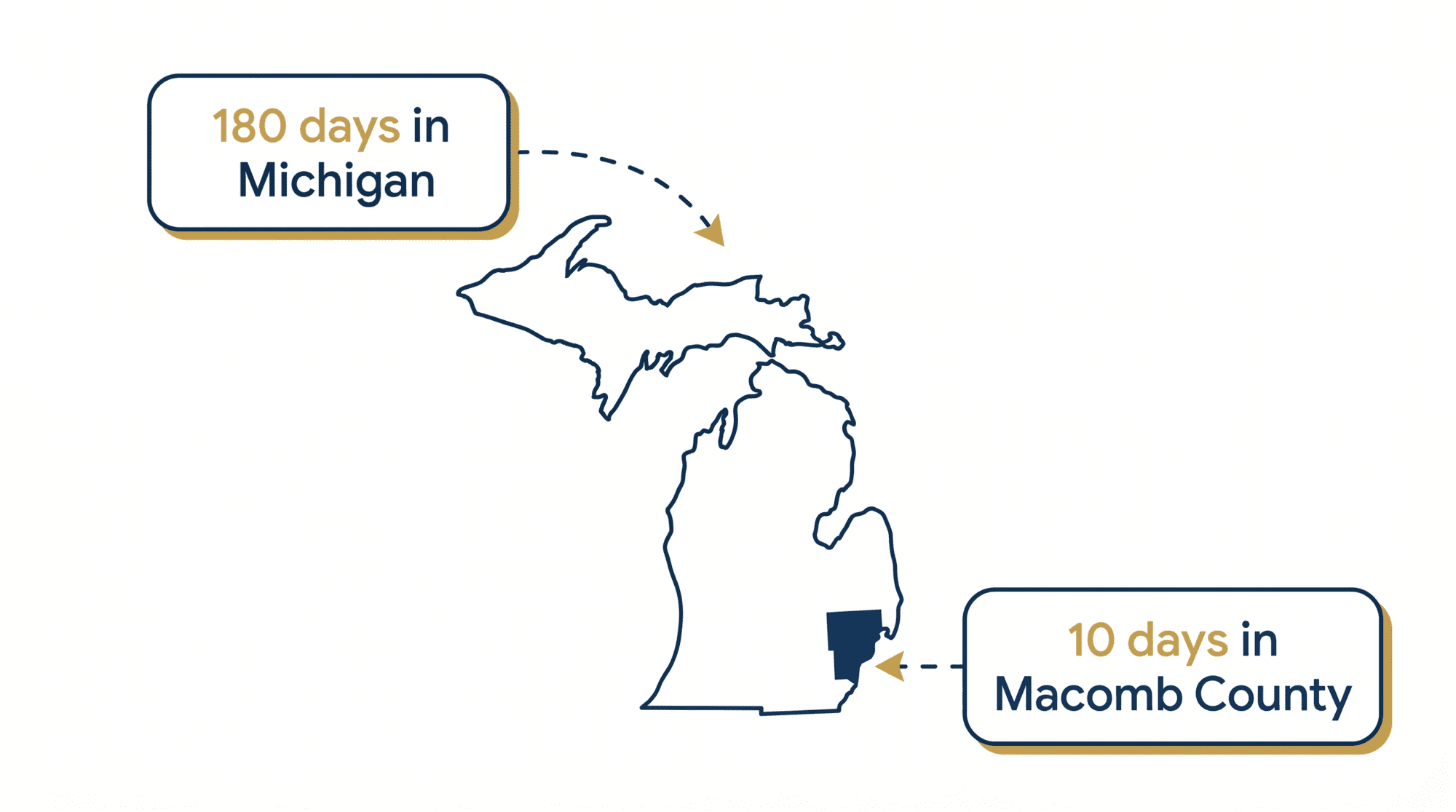
Before anything else, you need to confirm you’re eligible to file in Macomb County. Michigan has two residency thresholds:
State residency: You or your spouse must have lived in Michigan for at least 180 days (about 6 months) before filing.
County residency: At least one of you must have lived in Macomb County for a minimum of 10 days before filing.
If you recently moved to Macomb County from somewhere else in Michigan, that 10-day county requirement is what matters. You don’t need to restart the clock on the 180-day state requirement as long as you’ve been a Michigan resident the whole time.
One thing that trips people up: if your spouse lives in a different county, you generally file in the county where the defendant (the person being served) lives. But if you’ve lived in Macomb County for the required 10 days and you’re the one filing, you can file here. Talk to an attorney if your situation is complicated on this point.
Where to file
All divorce cases in Macomb County go through the Macomb County Circuit Court (16th Judicial Circuit), located at:
40 North Main Street, Mt. Clemens, MI 48043
The clerk’s office is where you’ll submit your paperwork. You can also find many of the required forms on the Macomb County Circuit Court website or through the Michigan Courts One Court of Justice website (courts.michigan.gov).
Required forms and documents
The paperwork can feel like a lot, but it breaks down into a few core documents:
Complaint for Divorce — This is the main document that officially starts your case. It names both parties, states the grounds for divorce (Michigan is a no-fault state, so the standard language is that “there has been a breakdown in the marriage relationship to the extent that the objects of matrimony have been destroyed and there remains no reasonable likelihood that the marriage can be preserved”), and outlines what you’re asking for in terms of custody, property, and support.
Summons — This notifies your spouse that a divorce case has been filed against them. It gives them a deadline to respond (typically 21 days if served in Michigan, 28 days if served outside the state).
Verified Statement and Application for IV-D Services — Required in cases involving minor children. This form gives the Friend of the Court the information they need to get involved in custody and support matters.
Record of Divorce or Annulment — A short form that captures vital statistics for state records.
Uniform Child Custody Jurisdiction Enforcement Act Affidavit (UCCJEA) — Required if you have minor children. This establishes that Michigan has jurisdiction over custody matters.
If your situation involves children, there’s more paperwork. If it doesn’t, the stack is a bit thinner. Either way, you’ll want to double-check with the clerk’s office that your packet is complete before submitting. Missing a form means delays, and nobody wants that.
Filing fees
Expect to pay roughly $175 to file your Complaint for Divorce with the Macomb County Circuit Court. If your case involves minor children, there’s an additional $80 judgment fee.
You’ll also need to pay for service of process. If you hire a process server, that typically runs $50 to $75. Your spouse can also accept service voluntarily, which saves that cost entirely.
Fee waiver: If your household income is at or below 125% of the federal poverty guidelines, you may qualify for a fee waiver. The court has a specific form for this request, and a judge will decide whether to grant it. It’s worth asking about if money is tight.
Serving your spouse
After you file, your spouse needs to be officially notified. This is called “service of process,” and you can’t skip it. Michigan requires personal service, which means someone (not you) physically hands the Summons and Complaint to your spouse.
Your options for service:
A process server is the most common route. They’ll handle delivery and file proof of service with the court.
A county sheriff can also serve papers, though scheduling can take longer.
If your spouse is cooperative, they can sign an Acknowledgment of Service form, which eliminates the need for formal service. This is obviously the easiest path, but it only works if both parties are communicating.
If you genuinely cannot locate your spouse after reasonable efforts, you can petition the court for service by publication, which involves posting a legal notice in a local newspaper. This is a last resort and adds time to the process.
The waiting period

Michigan law imposes a mandatory waiting period between the date you file and the earliest date a judgment of divorce can be entered:
No minor children: 60 days minimum.
Minor children involved: 6 months (180 days) minimum. A judge can shorten this to 60 days in some circumstances, but that requires a motion and good cause.
These waiting periods are minimums. If your case is contested and involves disputes over custody, property, or support, it will almost certainly take longer. Uncontested cases sometimes wrap up close to the minimum timeline, but don’t plan around it.
What happens after filing: the stages of a Macomb County divorce
Here’s what the process looks like once your case is filed and your spouse has been served.
Your spouse responds (or doesn’t). They have 21 days to file an Answer to your Complaint (28 days if served outside Michigan). If they don’t respond, you can request a default judgment, which means the court may grant your divorce on the terms you requested in your Complaint.
Friend of the Court involvement. If children are involved, the Macomb County Friend of the Court will be assigned to your case. They handle custody evaluations, recommend support amounts using the Michigan Child Support Formula, and can mediate disputes. The Friend of the Court office is located in the same building as the Circuit Court.
Discovery and negotiation. In contested cases, both sides exchange financial documents, tax returns, bank statements, and other relevant information through a formal process called discovery. This is where your attorney negotiates on your behalf regarding property division, custody, and support. If your spouse isn’t being forthcoming about finances, your attorney can file motions to compel disclosure. Many cases settle during this phase without ever going to trial.
Mediation. Macomb County judges commonly refer couples to mediation, especially for custody and property disputes. A neutral mediator helps both sides reach an agreement. Mediation costs less than a trial and tends to produce outcomes that both parties can live with.
Settlement conference or trial. If mediation doesn’t resolve everything, the judge may schedule a settlement conference. If the case still doesn’t settle, it goes to trial. The judge hears evidence and testimony, then makes the final decisions on all unresolved issues.
Judgment of Divorce. Once all issues are resolved, the court enters a Judgment of Divorce. This is the final order that legally ends your marriage and spells out the terms of custody, support, and property division.
Documents to gather before you file
Having these ready will make the process smoother and help your attorney give you accurate advice from the start:
- Marriage certificate
- Birth certificates for any minor children
- Recent tax returns (last 2-3 years)
- Pay stubs and proof of income for both spouses
- Bank statements (checking, savings, investment accounts)
- Mortgage documents and property deeds
- Vehicle titles and loan documents
- Retirement account and pension statements
- Credit card statements and records of debts
- Health insurance information
- Any existing prenuptial or postnuptial agreements
You don’t need every single item on this list before you file. But the more organized you are upfront, the fewer surprises you’ll run into later. Your attorney will also be able to give you better advice when they have a clear picture of your financial situation from day one.
Michigan is a no-fault state — what does that mean for you?
Michigan is one of the states where you don’t need to prove that your spouse did something wrong to get a divorce. You don’t have to prove adultery, abuse, or abandonment. The only grounds for divorce in Michigan is that “there has been a breakdown in the marriage relationship to the extent that the objects of matrimony have been destroyed and there remains no reasonable likelihood that the marriage can be preserved.”
In practice, that means you just need to state that the marriage is broken. Your spouse can disagree, but a judge won’t force you to stay married. That said, fault can still come into play when a judge is deciding property division or custody arrangements. If one spouse wasted marital assets or if there’s a history of domestic violence, those factors matter even though they aren’t required to get the divorce itself.
Frequently asked questions
Where do I file for divorce in Macomb County?
You file at the Macomb County Circuit Court (16th Judicial Circuit) at 40 North Main Street, Mt. Clemens, MI 48043. The clerk’s office handles all divorce filings.
How long does a divorce take in Macomb County?
Michigan requires a minimum 60-day waiting period if no minor children are involved. If you have minor children, the minimum waiting period is 6 months (180 days). Contested cases typically take longer.
How much does it cost to file for divorce in Macomb County?
The filing fee is approximately $175. If minor children are involved, there is an additional $80 judgment fee, bringing the total court cost to about $255.
Do I need a reason to file for divorce in Michigan?
No. Michigan is a no-fault divorce state. You only need to state that there has been a breakdown in the marriage relationship. You do not need to prove adultery, abuse, or any other fault.
Talk to a Macomb County divorce attorney

Filing for divorce is a legal process, and the decisions made early on affect your finances, your living situation, and your family for years afterward.
Aiello & Associates has handled divorce cases in Macomb County for over 40 years. If you’re considering filing, or if you’ve already been served and need to respond, call us at 586-303-2211 for a free consultation. We’ll walk through your specific situation and help you figure out the right next step. Contact us online to get started.

Related Posts

August
Divorce Mediation in Macomb County: How It Works, What It Costs, and When It’s Required
Divorce mediation is a process where a neutral third party helps both spouses reach an agreement on custody, support, and property without a trial. In Macomb County, the 16th Judicial Circuit Court routinely refers divorcing couples to mediation for custody and property disputes before a…

August
How to Modify a Custody, Parenting Time, or Child Support Order in Macomb County
To modify a custody order, a parenting time order, or a child support order in Macomb County, you file a motion with the court that issued it and show either proper cause or a change of circumstances since the last order. A judge in the…

July
Can I Move Out of State With My Child After a Michigan Divorce? Change of Domicile Rules
In most cases, no, not without either the other parent's consent or the court's permission. Michigan's change of domicile law (MCL 722.31) generally bars a parent who shares custody from moving a child more than 100 miles from where the child lived when the case…
Start With A Free Initial Consultation
Email us below or call 586-303-2211 to learn your legal options.
Contact Us Today!

Attorney Advertising. This information is designed for general information only. The information presented should not be construed to be formal legal advice nor the formation of a lawyer/client relationship. Past results and testimonials are not a guarantee, warranty, or prediction of the outcome of your case, and should not be construed as such. Past results cannot guarantee future performance. Any result in a single case is not meant to create an expectation of similar results in future matters because each case involves many different factors, therefore, results will differ on a case-by-case basis. By providing contact information, users acknowledge and give explicit consent to be contacted via the methods of communication provided, including SMS. Message and data rates may apply. Message frequency may vary. Reply STOP to opt out.
Attorney Advertising. This information is designed for general information only. The information presented should not be construed to be formal legal advice nor the formation of a lawyer/client relationship. Past results and testimonials are not a guarantee, warranty, or prediction of the outcome of your case, and should not be construed as such. Past results cannot guarantee future performance. Any result in a single case is not meant to create an expectation of similar results in future matters because each case involves many different factors, therefore, results will differ on a case-by-case basis. By providing contact information, users acknowledge and give explicit consent to be contacted via the methods of communication provided, including SMS. Message and data rates may apply. Message frequency may vary. Reply STOP to opt out.
Copyright 2026 | All Rights Reserved | Privacy Policy | Terms Of Use | Accessibility Notice